
I attended the 2015 NAIAS as a guest of Ford. I have not received any compensation for this post. Please note that, as always, any personal opinions reflected in this post are my own.
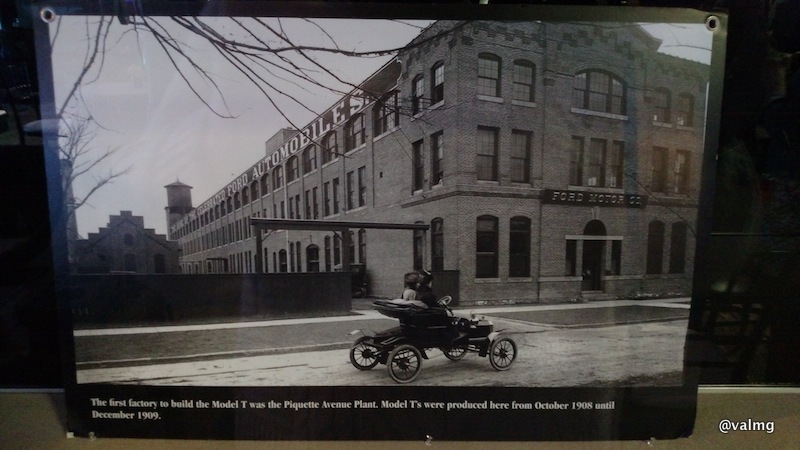
Last week I had the exciting honor of attending the 2015 North American International Auto Show in Detroit and the 2015 Ford NAIAS Digital Summit. For a car lover like me this was heaven! On the first night our group toured and had dinner at the first Ford Plant ever built, the Piquette Avenue Plant in Detroit. The Piquette plant is a gem tucked away amongst rubble. Literally. It sits in the midst of an industrial area where the landscape consists of abandoned buildings, burnt out buildings, small shops and even some small halls of worship. The brick building that is the Piquette AVenue plant was built in 1904 and is the place where the first Model T’s were made. It has been designated as a National Historic Landmark and has been placed on the National Register of Historic Places.
Upon entering the building what I saw took my breath away. Many classics from past decades were there on display, just waiting to be admired and drooled over once again. Along with the amazing cars we also saw the plant’s secret experimental room. Tucked in the corner of the third floor, this room was where brainstorming on features and improvements to current models and development of future models took place.
Back in the day, there were no assembly lines. Workers brought the parts to their stations and vehicles were assembled in one spot. It was a very time consuming process. Model T may well be the most well-known early Ford automobile but it wasn’t the first Ford automobile. There were a number of other Model models before it, including B, C, N and T to name a few. Some never made it past one build, others had a slightly larger number built. It was in this plant that Henry Ford realized in order to achieve his dream of making an affordable car for everyone something had to change in production. More cars had to be made in order to drive costs down. It was in this plant that he came up with the idea of a moving assembly line, the technique that is still used in auto plants today. As the assembly line came to be in a new plant and production increased, production ceased at the Piquette Plant.
Our group was able to sit with both Ford Futurist Sheryl Connelly and manager of the Ford North American Archives Dean Weber. It was very interesting to see photos and video clips from the past, and to hear about how Ford works to look forward but also looks to the past to help guide future innovations, technology and designs. The past meeting the present was the theme for the night, and as it turned out for the next two days as well.
Here’s a quick slideshow with some of my favorite photos from the Piquette Plant.
The Ford Piquette Avenue Plantis open for public tours during the NAIAS. Public tours are availble January 17-18 and January 24-25, 2015 from 10 am to 4 pm (last tour leaves at 3:00 pm). Private tours and events are held year round. You can learn more on the website, and they are on Facebook as well.
CONNECT
Ford Motor Company website – Ford Motor Company on Facebook – Ford Motor Company on Twitter
Some posts on this site contain an affiliate link. Affiliate links are used in an attempt to offset the operational costs incurred by running this website. Clicking on an affiliate link does not increase the cost of the product if you buy it. It does mean that I MAY make a commission if you purchase the item. As an Amazon Associate I earn from qualifying purchases.

What an amazing experience. I would love to tour there someday.
That looks so amazing. I’d LOVE to visit and see all of the cool cars.
I can’t believe all of the different cars they had there. How fun!
How neat! All of those old cars are so cool. It’s really mind blowing to look at them, look at what we have now, and realize that cars have only been around for a short while.
I think it would be so cool to see the antique cars. I would love to take my son to see them. He likes that sort of thing!
What a great look at the history of cars! My brother-in-law used to work in a car manufacturing plant and it is amazing just how much it has all changed since the very beginning.
It was great to meet you! Even if it was briefly but, what an experience it was to visit Piquette Plant. Where it all began! 🙂 So amazing.
I have always been a fan of Ford. They are such a great and trustworthy brand.
This sounds like an awesome place! I’m loving those old school autos!
What an exciting and informative experience! I bet it was interesting to learn all about the history of the company and to see how far it has come today 🙂
Things like this are really cool. I spent about ten years working in the auto industry and got to spend a lot of time in assembly plants (usually because my company screwed up) but never got to see anything like this.
How awesome! Looks like soo much fun.
What a great experience! I love those old cars!
Loved the pictures; love Ford.