
I remember when i was at the end of my first pregnancy. My son was to be born soon and we had to get the car seat installed in my car. I have to admit, I needed help. I wasn’t sure that I did it right, and that’s definitely something you want to be sure is done right.
National Child Passenger Safety Week begins tomorrow, and runs from September 13-19. To help parents across the country ensure safety, Buckle Up for Life, the national education program from Toyota and Cincinnati Children’s, has shared the top five myths and facts on car seats.
“We know from our work with thousands of families across the country over the past decade that car seats can be frustrating. In fact, an alarming three out of four are not installed properly,” said Gloria del Castillo, child passenger safety expert at Cincinnati Children’s and national program manager for Buckle Up for Life.
Del Castillo continued, “Working closely with leading children’s hospitals across the country, Buckle Up for Life shares vital safety education with parents and caregivers. It is our hope that by doing this – including our latest campaign to dispel some very common myths – we can continue to make a difference in saving children’s lives.”
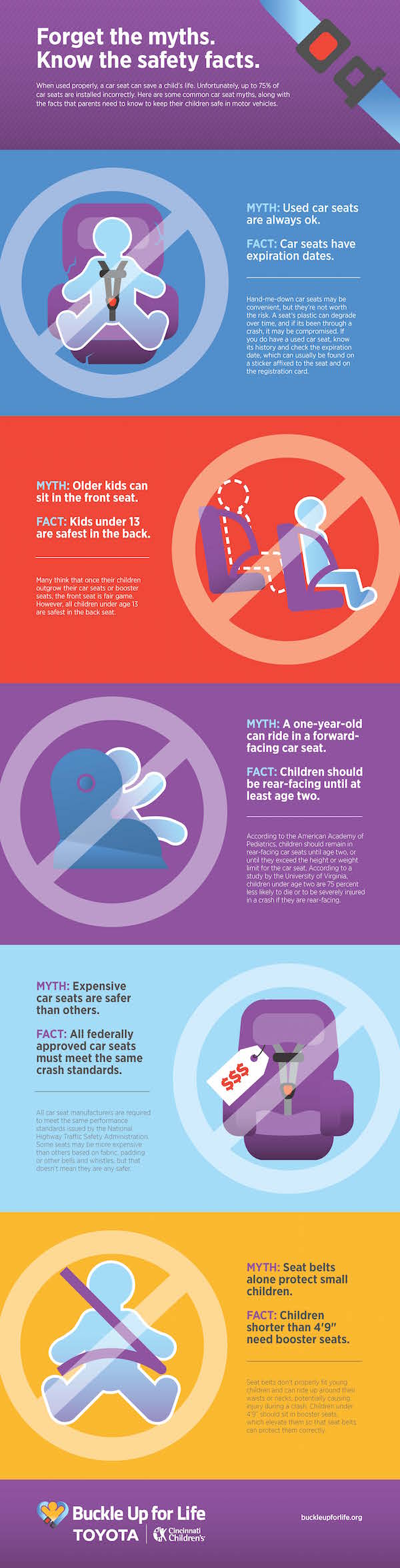
During its 2014 –2015 program cycle, Buckle Up For Life reached more than one thousand families with critical passenger safety information through partnerships with local children’s hospitals and community organizations. Organizations that offered the program observed a marked improvement in members’ auto safety behaviors, including:
- The rate of children unrestrained in cars decreased from one in four to fewer than one in 20.
- The rate of children in car seats increased from roughly one in four to one in two; and
- A 13 percent increase in use of seat belts for adults, from 68 percent to 81 percent.
This fall, Buckle Up For Life will launch in two new cities:
- C.S. Mott Children’s Hospital at the University of Michigan in Ann Arbor, MI
- Yale-New Haven Children’s Hospital in New Haven, CT
“Toyota has always been deeply focused on helping families get places more safely,” said Latondra Newton, Toyota’s Group Vice President and Chief Social Innovation Officer. “That is why we are so proud of the impact we’ve had with Buckle Up for Life. Together with our partners at Cincinnati Children’s, we offer life-saving education and resources to families to better protect young passengers.”
Toyota and Cincinnati Children’s Hospital Medical Center partnered in 2004 to create Buckle Up for Life, a national education program for families to help keep child passengers safe. The program teaches parents and children about the proper use of car seats and seat belts and provides free car seats to families in need. Through partnerships with the leading children’s hospitals in the country, Buckle Up For Life has reached more than 23,000 people in 14 cities. Toyota’s sponsorship has provided funding for over 40,000 car seats for families in need.

Always good to brush up on car safety.
The safety has changed since my kids were in a car seat. Always good to brush up on the latest info.
I was surprised that children are now suppose to be rear facing until they are 2 years old. The rules have definitely changed since my daughter was in a car seat but that was over 20 years ago.
I am happy to say that I actually did know all of these. I try to remain up to date on car seats rules and regulations! This is a great post and I will be sharing with my friends and family.
Thanks for this awesome infographic. It’s always good to be informed. Especially with precious cargo.
I am so happy to see that I follow all these car seat safety rules with my kids. My son is still in a booster and will continue to be for years to come.
I love that the infographic talks about expiration dates. That’s something that always worries me when people are selling used car seats.
Laws differ by state and weight/height counts more than age.
Thank you for this! My family is already saying my three year old should just be in a booster seat and I’m like NO WAY!
WOW- so much has changed since my kid were in the baby seats. I do understand that it’s for the safety of the little ones